Thursday, January 16, 2014

Letter from Betty, January 2014


Hello,

Happy New Year! I hope your 2014 is off to a great start.

We are proud of our students for their academic success as well as the successes they have in their nonacademic activities. Many of them spend hours on the athletic field, others work tirelessly to perform in school plays, and some play musical instruments in the school band or orchestra. We appreciate the dedication our students have for these activities, and we are proud of their accomplishments. This month's feature article, "Music and Learning," describes the surprising educational benefits of playing a musical instrument, including heightened memory skills, mathematics achievements, and reading ability.

Betty


Betty Bodenweiser
Director
Foundation for Learning

SAT/ACT Test Schedules

Mark your calendars! Here are the latest SAT, ACT, and SSAT test dates.


Music and Learning

Is your child involved in music studies? Does your child play an instrument? Is listening to music a part of your family activities?


For decades, research has been done on the effects that music has on a person in the areas of education, physical well-being, and stress relief. Back in the 1950s, a theory called the "Mozart effect" became popular, and parents began playing Mozart’s beautiful compositions, as well as other classical pieces, because people began to understand that music enhances a child’s life and development, including the area of academic performance.

An interesting study of children between the ages of 4-6 was published in 2006 by researchers at McMasters University. This group found that the kids that received musical instruction charted higher in memory skills, mathematics, and reading ability.

Older kids have been studied as well. The National Association for Music Educators focused on 16-18 year olds and found that those who had music built into their lives scored, on average, 56 points higher on verbal and 39 points higher on math portions of their SATs.


Academic investigators at McGill University studied how the body can be affected by listening to music. They found that dopamine is released in the brain at a higher rate when a person is exposed to music, helping to relieve stress and even bringing about positive effects for people dealing with anxiety and depression. They concluded that music helps people focus and improves both short-term and long-term memory.

Music can positively affect mood, evoke emotions, and boost energy. Additionally, music helps people to retain information, strengthens language skills, and enhances overall learning.

We know that there are different types of learners. For people who are aural learners, sound is the most effective way to understand the world and to gather information. Mnemonic techniques will help most people learn and memorize information, setting something to music in order to retain facts and trigger the memory at a later date. Remember how you learned your ABCs?


Researchers at Northwestern University gathered data from around the world linking musical training and the effects of music to all kinds of skills, including those areas mentioned above. Neuroplasticity is what neurologists call the physical changes the brain undergoes, the ability to adapt and make neural connections when a person is exposed to music and the nervous system is affected. Those neural connections are important to learning.

In the study of music, the student is reading, memorizing, visualizing, focusing on timing, understanding melodies and harmonies, and coordinating with other performers. The musician’s brain weaves a complex relationship between both sensory and cognitive activities. In their published studies, the researchers at Northwestern find that children who are trained in the musical arts are more acutely aware of pitch changes in speech, have better vocabulary and communication skills, and even better reading ability than kids that aren’t exposed to music and musical training.


Music helps provide brain fitness, shapes development, reinforces self-discipline, focus, listening, coordination, beat, rhythms, visualization, pronunciation, language (for reading music is indeed reading another language), and spills over to all areas of academic achievement. Music helps relieve stress and anxiety, supports memory skills, exposes us to different cultures, histories, and so many other aspects of the world around us. So expose your child to music in the home, take in concerts featuring different types of music, sing with your kids, encourage your child to study music either in school or privately outside of class. Music is as important to your child’s development and education as math or science, so support your local music scene and support music programs in our schools.

The Puzzler: Unusual Musical Instruments

Match each of the six rare and unusual musical instruments in the photos to its name on the list below. Extra credit: Name the famous American inventor in the photo at upper left.


  1. Hurdy Gurdy
  2. Koto 
  3. Moog Synthesizer
  4. Glass Armonica
  5. Harmonium
  6. Viol de Gamba


Answer next month!


--------------------------------------------------------------------------------------


LAST ISSUE'S PUZZLER: An Animated Christmas, with ANSWER
 
Match each of the four images below to a quote from the list. Extra credit: Name the character who spoke the quoted line!


  1. “Say, by the way, can you play ‘Jingle Bells?’” 
  2. “Santie Claus, why? Why are you taking our Christmas tree? Why?” 
  3. “Hey Buddy, wanna pick some snowberries?”
  4. “Someday I’d like to be…a dentist.” 
Do you know who said what?


Scroll down...


Scroll down...


Scroll down...


Scroll down...


ANSWERS: 
  1. “Say, by the way, can you play ‘Jingle Bells?’” ....D: Lucy van Pelt from "A Charlie Brown Christmas"
  2. “Santie Claus, why? Why are you taking our Christmas tree? Why?” ...A: Cindy Lou Who from "How the Grinch Stole Christmas"
  3. “Hey Buddy, wanna pick some snowberries?” ...B: Arctic Puffin from "Elf"
  4. “Someday I’d like to be…a dentist.” ...C: Hermie from "Rudolf the Red Nosed Reindeer"

Wednesday, December 18, 2013

Letter from Betty for December 2013

Hello,

Happy Holidays! During this exciting time of year, remember to relax and enjoy your family and friends. But also remember that the beginning of a new year is a good time to establish goals for yourself and children. Organization is one area included on most of our New Year’s resolution lists. Help your children to reorganize and clean out knapsacks, binders, and notebooks, and purchase new ones if necessary. Now is also a good time to begin organizing material for midterm exams, if appropriate. Use this downtime constructively so 2014 starts off strong!

Many of our students will spend some time over the break working towards their goals. Most 8th graders applying to private schools have taken their high school admissions tests, but many are finishing up applications. High school juniors are focusing on SAT/ACT test prep, while others will start preparing in January. Finally, high school seniors are working on their college applications.

Make it a productive break and, as I tell my students, do whatever you can do today to make tomorrow easier!

Please remember to call us at Foundation for Learning if we can help you in these areas or with any other academic needs.

Happy Holidays!

Betty


Betty Bodenweiser
Director
Foundation for Learning


SAT, ACT, and SSAT Test Schedules

Here are some dates to mark on your calendars.


Flying Reindeer and Reindeer Chow

We all know Rudolph, the most popular of Santa’s reindeer, but how much do you know about the other reindeer that pull the famous sleigh each year?


Washington Irving wrote in 1812 about the magical St. Nicholas, who would ride in a wagon over the tops of trees in order to bring Christmas gifts to children. But in his story, "A Complete History of New York," Irving never mentions how the wagon is moving about through the sky. It’s not until 1821, when a poem written by an anonymous author called "A New Year’s Present" is published in New York that we first learn that reindeer are pulling the famous sleigh along.

Old Santeclaus with much delight
His reindeer drives this frosty night.
O'er chimneytops, and tracks of snow,
To bring his yearly gifts to you.

In 1823, Clement C. Moore wrote "A Visit From St Nicholas," which is more popularly known as "The Night Before Christmas." In this poem Moore firmly plants the tale of eight flying reindeer into our holiday traditions and is the first accounting of the actual names of the creatures.

When what to my wondering eyes should appear,
But a miniature sleigh and eight tiny reindeer,
With a little old driver, so lively and quick
I knew in a moment it must be St. Nick.

More rapid than eagles his coursers they came,
And he whistled and shouted and called them by name;
"Now, Dasher! now, Dancer! now, Prancer and Vixen!
On, Comet! on, Cupid! on, Dunder and Blixem!
To the top of the porch, to the top of the wall!
Now, dash away, dash away, dash away all!"


Rudolph, the lovable red-nosed outcast who later becomes a hero, was first brought to us by Robert May, who wrote a book in 1939 for the Montgomery Ward Department Stores that was to be given as a gift to children who visited the store’s Santa.

Did you notice that two of the reindeer are named Dunder and Blixem? Well those names actually are Germanic words that translate to thunder and lightning. It’s not surprising that we’d see those German names as these stories originated in New York, which was initially called New Amsterdam and settled by Dutch and German immigrants. Well, in 1949, Johnny Marks composed the enormously popular song, "Rudolph the Red-Nosed Reindeer," based on the Robert May book, and in it those two reindeer are named Donner and Blitzen, and those two names remain the popular versions today.

So why reindeer? Well, many of our Christmas traditions were brought to us by early Dutch and German immigrants, and along with them came their customs and their own stories. In their homelands, the reindeer population was quite widespread and once the majestic creatures were domesticated they were popularly used for transportation…including pulling sleds and sleighs.


So this season, while you’re creating your wonderful holiday cookies, why not whip up a batch of Reindeer Chow too? It could be a new tradition in your own home!


Reindeer Chow

1 box Crispix or Chex cereal
1 small jar peanut butter
1 box powdered sugar
1 package semi-sweet chocolate chips
1 stick butter


In a small saucepan, melt the chocolate chips, butter, and peanut butter over low heat, stirring constantly until liquidy and hot.

Pour the cereal into a large bowl (make it plenty large because you’ll need room!) and when the chocolate mixture is ready, pour over the cereal. With a wide spoon, gently stir until all the cereal pieces are evenly coated. Let sit for a few minutes until it cools a bit.

Meanwhile, pour half of the powdered sugar into a brown grocery bag. Once the cereal mixture is sufficiently cooled, pour the contents of the bowl into the brown bag and then pour in the remainder of the powdered sugar.

Roll the brown bag closed and shake, shimmy, and roll the contents around in the bag until the contents are completely coated with the sugar. This may take a few moments, so have a good time dancing around the kitchen with your kids while doing this step of the recipe.

Once covered, let the reindeer chow sit in the brown bag until cooled. Store in an airtight container.

Enjoy!

The Puzzler: An Animated Christmas

Match each of the four images below to a quote from the list. Extra credit: Name the character who spoke the quoted line!

 1. “Say, by the way, can you play ‘Jingle Bells?’”
 2. “Santie Claus, why? Why are you taking our Christmas tree? Why?”
 3. “Hey Buddy, wanna pick some snowberries?”
 4. “Someday I’d like to be…a dentist.”


Answer next month!


--------------------------------------------------------------------------------


LAST ISSUE'S PUZZLER: The Kingdom of Castles, with ANSWER

Once upon a time in the Kingdom of Castles there lived a prince in search of a bride. The prince searched throughout the kingdom. One afternoon, after many hours of seeking hither and yon, the prince spied a fair maid fetching some water from Castle Creek. The prince fell instantly in love.


“Greetings and well met, fair maid!” said the prince, “I am Prince Phillip, future king of all this land. Will you marry me?”

“Nay, bold prince, it cannot be,” said the fair maid, “unless you can answer my riddle. For the man who marries me must be clever beyond compare.”

“Speak your riddle then, beautiful maid, and I will answer it, and you shall be my bride.”

“You are confident, good prince, but we shall see if you are clever. Here is my riddle:

Forty men and forty horses
may not move it one hair.
As large as yonder castle,
yet lighter than air?
What am I?”

The prince proceeded to make 99 guesses but each time the fair maid replied, “Nay, nay, try once more.” Finally the prince smiled a princely smile and said: “I have got it at last, and now you will be my bride!”

The prince gave his final guess and the fair maid smiled and held out her arms and said, “Now I shall be your bride, for you are clever indeed!

What is the answer to the fair maid’s riddle?

Scroll down...


Scroll down...


Scroll down...


Scroll down...


ANSWER:
The shadow of a castle.


Monday, November 25, 2013

Letter from Betty for November 2013

Hello,

The holiday season is upon us, as is the hustle and bustle and excitement that comes along with it. During this time it is important to maintain the established routines that you have worked so hard to develop this school year. Holiday parties, household guests, and school concerts can make this challenging. Keep your children on strict bedtime schedules and homework routines to maintain the structure that will be needed during the busy time. Once vacation starts, vary your schedule to accommodate your activities, but a few days before the kids return to school, help them get back to their regular sleep schedule so 2014 starts off on the right foot.

High school juniors, keep your eyes peeled for your PSAT scores!

Happy Holidays!

Betty


Betty Bodenweiser
Director
Foundation for Learning


SAT/ACT Test Prep and Schedules

December begins the SAT/ACT cycle for high school juniors. PSAT results will be revealed early in the month; these scores will give us detailed information about specific areas that our students need to focus on in preparation for taking the tests in the spring. Once the PSAT scores come in, please give us a call so we can answer your questions and reserve a place on both Donna and Elin’s calendars. Our students typically begin SAT/ACT prep in December or January, so it is important to call early to secure your preferred time slot.


SAT, ACT and SSAT Schedules

Did You Know? Lesser Known Facts About Thanksgiving

  • As children we were taught that the first Thanksgiving took place in Plymouth Colony (in present-day Massachusetts) in 1621, but did you know that it was more than 200 years later that President Abraham Lincoln declared the last Thursday in November as a national day of thanksgiving? 


  • That Sarah Josepha Hale, who actively campaigned to have Congress declare Thanksgiving an official national holiday, also penned the ever-popular nursery rhyme "Mary Had a Little Lamb?” Congress did, in fact, make this declaration in 1941. 
  • That approximately 42.2 million Americans travel 50 miles or more from home on Thanksgiving? We Americans certainly yearn to go home for the holidays! 
  • That just six states—Arkansas, Indiana, Minnesota, Missouri, North Carolina, and Virginia—account for nearly two-thirds of the turkeys that are raised in the U.S. each year? 
  • That Massachusetts, New Jersey, Oregon, Washington, and Wisconsin are the top cranberry growing states? 
  • That California, Illinois, New York, and Pennsylvania are the major pumpkin growing states? Total US pumpkin production exceeds 1.5 billion pounds each year! 
  • That North Carolina produces more sweet potatoes than any other state in the US? Along with California and Mississippi, over 2.4 billion pounds of sweet potatoes are grown each year! 
  • That the Guinness Book of World Records documented the largest pumpkin pie ever baked weighed 2,020 pounds? Baked on October 8, 2005 by the New Bremen Giant Pumpkin Growers in Ohio, the recipe called for 900 pounds of pumpkin, 62 gallons of evaporated milk, 155 dozen eggs, 300 pounds of sugar, 3.5 pounds of salt, 7 pounds of cinnamon, 2 pounds of pumpkin spice, and 250 pounds of crust. That’s a lot of pie! 
  • That across America, “traditional” Thanksgiving dishes are quite varied? You’ll find oysters on the East Coast, Dungeness crab on the West Coast. Stuffing may be made from cornbread, might include sausage, and maybe even chestnuts, depending on the particular region. 
  • That the first Macy's Thanksgiving Day Parade took place in New York City in 1924 and featured animals from the Central Park Zoo? 


  • That Snoopy has appeared as a giant balloon in the Macy's Thanksgiving Day Parade more times than any other character in history? More than 3 million people line the streets of NYC each year to view the parade and over 44 million people watch the parade on their TVs each year as a part of the Thanksgiving Day tradition. 


Try these fun, regional Thanksgiving Holiday recipes (and be sure to include the kids in the kitchen fun!) 


King’s Arm Tavern Cream of Peanut Soup (Williamsburg, Virginia) 

1 medium onion, chopped
2 ribs of celery, chopped
¼ cup butter
3 tbsp all-purpose flour  
2 cups smooth peanut butter  
1 ¾ cups light cream
Chopped peanuts (for garnish) 
2 qt chicken or vegetable stock 

Sauté onion and celery in butter until soft, but not brown. Stir in the flour until well blended. Add stock, stirring constantly, and bring to a boil. Remove from the heat and puree in food processor or blender. Add peanut butter and light cream, stirring to blend thoroughly. Return to low heat and heat until just hot (about 10 minutes). Do not boil. Garnish with peanuts and serve immediately. 

Yield: 10-12 servings 


Grandma’s Candied Yams (North Carolina) 

3 medium sweet potatoes (about 2 lbs) 
2 tbsp butter
1/3 cup raisins
Pinch of salt
½ tsp cinnamon  
1/3 cup maple syrup, honey, or molasses  
2 tbsp lemon or orange juice  
½ to ¾ cup miniature marshmallows 

Preheat oven to 350 degrees. In a large pot of boiling water, cook sweet potatoes until tender, about 40 minutes. When sweet potatoes have cooled, peel them and cut into ½ inch slices. Place in baking dish, dot with butter and sprinkle with raisins. Top with salt, cinnamon, and maple syrup, honey, or molasses. Drizzle with juice and bake for 25 minutes. Remove from oven, top with marshmallows, and bake for an additional 5 minutes, until marshmallows have browned. Serve hot. 

Yield: 4 to 6 servings 


New Prague Hotel’s Candied Apple Wedges (New Prague, Minnesota) 

6 to 8 apples, Jonathan or Winesap 
2 tbsp butter
1 cup brown sugar  
Pinch of salt 

Core apples and slice into wedges. Do not peel. In a frying pan, dissolve brown sugar in butter. Add apples and a pinch of salt. Cook uncovered on very low heat for 1 hour, turning frequently. Serve immediately. 

Yield: 6 to 8 servings 


Grandma’s Baking Powder Biscuits (Maine) 

2 ½ cups all-purpose flour 
2 ½ tbsp cream of tartar 
1 ¼ tsp baking soda 
¾ tsp salt 
2 tbsp shortening 
¾ cup milk 

Preheat oven to 425 degrees. In large mixing bowl, sift together flour, cream of tartar, baking soda, and salt. Work shortening into the mixture, first using a wooden spoon, then your fingers or pastry blender, a fork, or two knives. Stir in enough milk to make the dough very moist but not sticky – the secret to moist, puffy biscuits. 

Turn the dough out onto a very lightly floured board. Knead it up to 10 turns and then pat it into a flat circle. With a floured rolling pin, roll out the dough into ½-inch thickness. Cut into biscuits with a lightly floured 2-inch round cutter or glass. For crispy-crust biscuits, place biscuits about 1 inch apart on an ungreased baking sheet, closer together for soft-crust biscuits. Prick the top of the biscuits with a fork. Bake for 10 to 12 minutes, until golden brown. Remove from the sheet immediately and serve hot. 

Yield: 16 biscuits 


Mulled Cider (Arkansas) 

2 sticks cinnamon 
12 whole cloves 
2 tsp whole allspice 
1 gallon apple cider 
1 cup light brown sugar, firmly packed 
1 lemon, thinly sliced 

Tie cinnamon sticks, cloves, and allspice in a small cheesecloth bag. Pour cider into a large, heavy enamel kettle, then add bag of spices and brown sugar. Simmer, uncovered, for 15 minutes. Remove the bag of spices. Pour cider into a metal or heatproof punch bowl, float lemon slices on top, and serve hot. 

Yield: 12 servings


The Puzzler: The Kingdom of Castles

Once upon a time in the Kingdom of Castles there lived a prince in search of a bride. The prince searched throughout the kingdom. One afternoon, after many hours of seeking hither and yon, the prince spied a fair maid fetching some water from Castle Creek. The prince fell instantly in love.


“Greetings and well met, fair maid!” said the prince, “I am Prince Phillip, future king of all this land. Will you marry me?”

“Nay, bold prince, it cannot be,” said the fair maid, “unless you can answer my riddle. For the man who marries me must be clever beyond compare.”

“Speak your riddle then, beautiful maid, and I will answer it, and you shall be my bride.”

“You are confident, good prince, but we shall see if you are clever. Here is my riddle:

Forty men and forty horses
may not move it one hair.
As large as yonder castle,
yet lighter than air. What am I?”

The prince proceeded to make 99 guesses but each time the fair maid replied, “Nay, nay, try once more.” Finally the prince smiled a princely smile and said: “I have got it at last, and now you will be my bride!”

The prince gave his final guess and the fair maid smiled and held out her arms and said, “Now I shall be your bride, for you are clever indeed!”

What is the answer to the fair maid’s riddle?


Answer next month!


--------------------------------------------------------------------------------


LAST ISSUE'S PUZZLER: Five Famous Americans, with ANSWERS

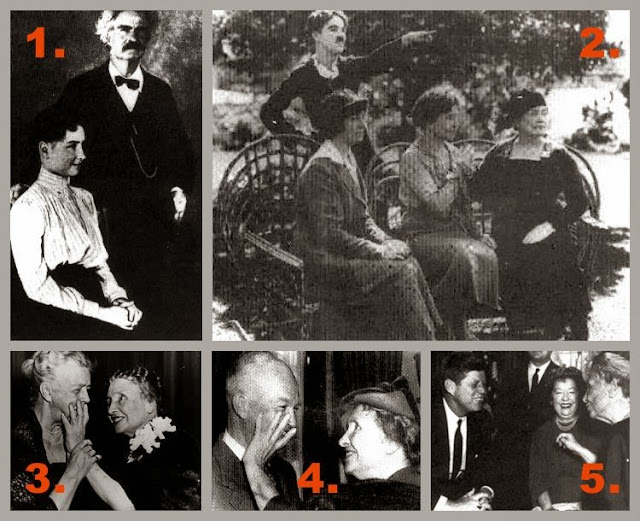
Our feature article last month showed Helen Keller with Alexander Graham Bell. Helen also met and touched and befriended many other famous Americans.

QUESTIONS: Can you name all five famous Americans shown with Helen Keller in the photos below?


ANSWERS:
1. Mark Twain, author
2. Charlie Chaplin, actor
3. Eleanor Roosevelt, First Lady
4. Dwight D. Eisenhower, US President
5. John F. Kennedy, US President

Monday, October 21, 2013

Letter from Betty for October 2013

Hello,


We are in the midst of an exciting, yet busy time of year for high school juniors and seniors. Juniors are patiently waiting the results of their PSAT scores and while many have already started prep for the SAT and/or ACT, others will start in mid-December or the first of the year. Seniors are completing early admissions college applications to meet the November 1st deadline. They are also visiting various college campuses so they will be better prepared to gauge where they will complete their undergraduate studies.


Good luck to all upperclassmen while you journey through the maze of the college application process. If there is anything we can do to make the process more positive and less stressful, please let us know.

If you haven't seen our College Wall yet, please stop by for a look. New pennants are added to it frequently to recognize and honor past FFL students and the colleges they attend. This year's additions include: Boston College, James Madison University, Skidmore College, William Paterson University, Michigan University, and Washington and Lee. Congratulations, graduates!


Best Regards,

Betty Bodenweiser

Test Schedules for October 2013

SAT, ACT and SSAT Schedules


How Helen Keller Learned

We know that there are different types of learners and different ways to learn, but the life of Helen Keller is an amazing example of creative instruction and how a ferocious desire to learn can break down barriers and take a student to great heights. Helen Keller (June 1880–June 1968) was a remarkable woman who overcame tremendous personal barriers to become a celebrated American author, political activist, and humanitarian.

Though she is remembered as being deaf, dumb, and blind, she actually was born with the ability to see and hear but lost those senses when she became ill and developed a very high fever when she was just 19 months old. She was closed off from the world except through her sense of touch, and her parents lost their ability to communicate with their daughter. Over time, she developed signs that she could use to “talk” with her family, but because she was so isolated her behavior became very unruly and unmanageable. Just imagine what it was like, how frustrating it was for her to be unable to see or hear the world around her, or to speak or hear the voices of her family.


In 1886, Helen’s mother read a story by Charles Dickens about another deaf/blind woman named Laura Bridgman who was successfully taught to interact with the world. Helen was sent to Baltimore for an evaluation and then was referred to Alexander Graham Bell (the inventor of the telephone, shown with Helen in the photo here), who was working with deaf children at the time. Bell referred Helen to a special school for the blind and there was assigned to recent graduate, Anne Sullivan. Sullivan, who herself was visually impaired, began using a series of techniques to break down the walls that kept Helen so isolated within herself. Endlessly repeating a series of finger motions on the palms of the Helen’s hands (who was extremely frustrated by this exercise) and alternatively running cool water over her hands, Helen excitedly understood the connection between the fingertip touch on her palm and the cool liquid. Anne finally got through to her and Helen learned the idea/symbols for “water.” From there, Helen frantically demanded the names of all the familiar objects, and her world suddenly expanded. A 49-year relationship with Sullivan began.


Together, Anne and Helen moved to Massachusetts to receive schooling from the Perkins Institute for the Blind and then moved to New York to attend the Wright-Humason School for the Deaf and the Horace Mann School for the Deaf. In 1900 they returned to Massachusetts and Helen was admitted to Radcliffe College, where she became the first deaf/blind person to earn a Bachelor of Arts degree.

Helen’s education did not stop there. She was determined to communicate with others as conventionally as possible, to expand her reach to other people, so Anne Sullivan, still at her side, developed a technique where Helen could use her fingertips to touch Anne’s nose, mouth and throat to feel the different vibrations that different letters and words make. In this way, Helen learned to “hear” and use her own voice to communicate. Wanting to expand her experience even further, she was determined to understand music, and with the patient assistance of the Zoellner Quartet, a highly acclaimed chamber music group originally from Brooklyn, New York, Helen spent hours sitting near the group while they played, touching her fingertips to a nearby tabletop so she could feel the resonant vibrations. In this way, Helen learned about the different musical notes, how the notes worked together and combined with rhythm and pacing, allowing her to “hear” and understand chamber music.

Helen went on to lecture and give speeches advocating for services for the deaf/blind community, workers rights, women’s rights, and women’s health, and is also credited as being a co-founder of the ACLU.


“I long to accomplish a great and noble task, but it is my chief duty to accomplish humble tasks as though they were great and noble. The world is moved along, not only by the mighty shoves of its heroes, but also by the aggregate of the tiny pushes of each honest worker.” ~Helen Keller

“Literature is my Utopia. Here I am not disenfranchised. No barrier of the senses shuts me out from the sweet, gracious discourses of my book friends. They talk to me without embarrassment or awkwardness.” ~ Helen Keller

“The best and most beautiful things in the world cannot be seen or even touched. They must be felt within the heart.” ~ Helen Keller

For further reading on the amazing life of Helen Keller:

The Story of My Life: With Her Letters (1887-1901) and a Supplementary Account of Her Education, Including Passages... by Helen Keller and Annie Sullivan (Jul 24, 2011)

Helen Keller (Scholastic Biography) by Margaret Davidson and Wendy Watson (Apr 1, 1989)

And here is a great video from a 1930 newsreel of Helen Keller and her teacher Anne Sullivan:


The Puzzler: Five Famous Americans

Helen Keller met and touched and befriended many famous Americans.

QUESTIONS: Can you name all five famous Americans shown with Helen Keller in the photos below?

1.


2.


3.


4.


5.


Recognize these five famous Americans? Answers next month!


------------------------------------------------

LAST ISSUE'S PUZZLER: Planet Tri-Gravito, with ANSWER

On the very strange planet of Tri-Gravito the Yellowers, Reddians and Blueys live on three different planes of gravity. Each group's floor is the next group's wall. It is very confusing and even dangerous for everyone. An emergency plan has been proposed that all residents should wear brightly colored yellow, red or blue outfits in order to avoid severe injury. As you can see here, only the leader from each group is wearing the colored safety uniforms. The entire population of 15 people is visible in the picture.

QUESTION:
How many more of each color uniform (yellow, red, and blue) are needed?


For the answer, scroll down...


ANSWER: 4 more yellow, 5 more red, and 3 more blue uniforms.


This intriguing work of art, minus the colors, is "Relativity" from 1953, by M.C. Escher. More works by Escher may be found here.


Monday, September 23, 2013

Letter from Betty

Hello,

I hope that you have had a smooth transition into the new school year. Hopefully the homework routine, as well as the morning and nighttime routines, have been established.

One of the most important events of the school year, Back-to-School Night, is quickly approaching. This is when your child's teacher explains her goals for the class. She shares information about her teaching style and methodology, how she grades, and the requirements for a good grade, as well as upcoming projects. This is valuable information that helps to set the tone for the rest of the year. Listed below is the important information that you should take from the night: 

  • An overview of the school day
  • Knowledge of what the classroom looks like
  • What it's like to sit in your child's seat
  • The homework policy
  • How to contact the teacher 

This is not the time to talk to one-on-one with the teacher or ask specific questions about your child. Save those conversations for another time; tonight, focus on experiencing your child's daily routine.  Continue reading to learn questions that you can ask the teacher at Back-to-School Night.  

Best Regards, 

Betty Bodenweiser